

 RSS Feed
 Apple Podcasts
 Spotify
 Castro
 YouTube
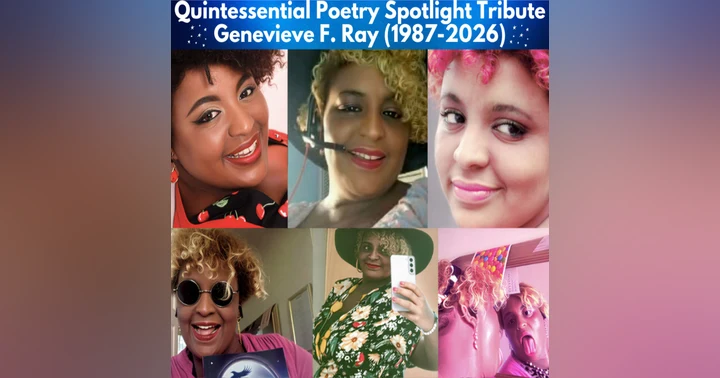
Quintessential Poetry Spotlight Tribute: Genevieve F. Ray (1987-2026)
We dedicate this rebroadcast to the loving memory of poet and spoken word artist Geneviève F. Ray (1987–2026).
This conversation is one of the brightest moments ever captured on Quintessential Poetry. Recorded on a Saturday morning across continents (January 23, 2023), this interview reveals Genevieve at her most luminous—honest, funny, vulnerable, brilliant, and fully herself.
In this episode, Genevieve speaks about
- poetry as a living companion
- neurodiversity and self‑understanding
- ancestry, identity, and belonging
- mental health and survival
- her one‑woman show Free Roaming Adult Woman
- the courage it takes to tell the truth
Her voice—her laughter, her pauses, her fire—remains a gift. This interview stands as a portrait of who she was when the world wasn’t watching, only listening.
About Genevieve Ray: Genevieve was a poet, performer, educator, and community builder whose work uplifted countless voices. Her debut poetry collection, Free Roaming Adult Woman, is still moving readers around the world.
May her words continue to rise. May her fire continue to guide.
00:00 Welcome to Quintessential Poetry + Meet Genevieve Ray
01:55 What Is Poetry? Genevieve’s Definition & Why It’s Human Nature
03:49 Finding Her Voice: Pandemic, Identity, Neurodiversity & Advocacy
08:44 Why Poetry Matters: Access, Flexibility & Community Conversations
10:38 Why ‘Genevieve Firepoint’? The Phoenix Metaphor & Creative Rebirth
13:56 Performance: “Free Roaming Adult Woman” (and the Encore)
18:35 Literary Roots & Early Power of Poetic Language (William Blake)
23:43 Reading Together: William Blake’s “The Tyger” + Craft Talk
26:19 Guard Down or Wall Up? Persona, Truth, and the Poet’s Self
28:39 Performance: “For Eulogies” + Does Writing Poetry Hurt?
35:53 Themes & Mission: Love, Protest, Teaching, and Empowering Others
38:37 Performance: “Doubt” + Process—How Poems Start, End, and Get Edited
44:20 Performance: “The Muse Will Not Lift” + Influences & Theater Voice
50:10 Writing for Connection: Making Language Accessible
52:55 From Page to Stage: What Spoken Word Means
54:45 The Poet’s Role Today: Emotional Journalism & Ancestry
57:22 Can Poetry Be About Anything? From Rocks to Stamps
01:07:38 Mentorship & Finding Your Voice: “Collect the Gems, Build the Crown”
01:14:21 Mini Poetry Concert: “Trance (Six Minutes)” & Ophelia Reimagined
01:18:43 Destiny, Surprise, and What Poetry Gives Back
01:24:25 What’s Next Creatively: Travel, Collaborations, One-Woman Show
01:26:15 Poetry UK Behind the Scenes: Building Community on Facebook
01:29:33 Where to Follow Genevieve + Final Farewell
Thank you for listening to Quintessential Listening Poetry Online Radio and YouTube. If you enjoyed this episode, please consider subscribing to our podcast on your preferred platform to stay updated on new episodes. You can also leave a review on our podcast to help us improve our content and reach more listeners. Follow us on social media platforms like Twitter, Instagram, or Facebook to stay connected with us and join our community of poetry lovers. Finally, if you’re a poet or spoken word artist and would like to showcase your work on the podcast, please contact the host, Dr. Michael Anthony Ingram, at maingram@gmx.com. Thank you for your support and we look forward to sharing more poetry with you soon!
0:00 Welcome to the quintessential listening poetry online radio and YouTube podcast streamed live from the heart of Washington DC. Here you'll find a portal to vibrant voices, echoing souls, and an ongoing celebration of the extraordinary power of language. So prepare yourself to join host Dr. Michael Anthony Ingram and his special guests as they explore traditional and spoken word forms of poetry. Hello everyone. Welcome to the program. My very special guest. Genevieve Ray. Genevieve is a spoken word artist and poet from Bedfordshire in Great Britain. She's been published in 17 magazines and anthologies. She is working the theater as a director and a playwright for six years. Genevieve is currently working on her first book which is due to be released later this year. I am overly I'm overly excited to introduce Genevieve Ray. Hello Genevieve.
1:21 Hello Michael. Hi. Hi everyone. Hello. I am so glad that you're with me. I'm so glad we've been able to make this connection and truly bring about an international, I don't know, I'm just happy. I'm happy. I feel that. I feel that and the same. had such a joyful adventure actually into us starting to communicate and the fact that we vibe anyway is just so it feels like I'm already chatting to a friend and getting the chance to talk about all the things that we really really love so thank you so much for having me. Well let's begin this poetic journey.
2:03 Genevieve, what is poetry? For me and I have thought about this very much It is the way that humans chronicle our emotions and expressions. I think that the explosion in the industry of online poetry and the amount of writers that I've seen become first -time published is no mistake during particularly the pandemic. I think it is the way that we record our feelings and have done for history. The fact that across history, poetry and history have fed into each other, you read some of the classic Greek historians, you read some of the classic Arabic historians and their work is full of poetry and yet they're recording human activity, human emotion, human love. It is the way we do that and always have every single person has had a variation of I really want to say this to my crush and put it in their diary somewhere. It is one of the most natural human things you can do. It has deep significance. I would love to know if our very early ancestors used it as a way to tell their children's stories at night. I think it's something deeply natural to us. For me, it has been essential to finding myself and really caught me off guard.
3:28 If you had asked me back in the theatre days, so good, almost nine whole years ago of like work in between, I never have told you I was a poet. It really generally surprised me, but now I see it as integral to my being. Integral to your being? That's such a strong statement. Tell me more. I have been the person, and it's only through the responses of the dearest friends that I've known across the way that go, I didn't know. I'm going to quote somebody I used to live with. She said, you just kind of exploded and I'm like, yeah, I think you got it right. I found my voice through poetry because, and for a bit of backstory, for audience really, a lot of things happen very, very quickly. The pandemic, Black Lives Matter, different bits and pieces. And I was seeing lots of responses and I realized that the things that people were expressing already didn't fit my own reality, not even internal reality, I mean, external reality. And I found that... Poetry was the easiest way and quickest way to get the message I need to say across.
4:40 Could I do it in a page? Could I do it in two pages? I used to draw and write in novels and I'd got through doing a play text but it took me a while. I couldn't do long form writing. Using rhyme, rhythm, songwriting and all the rest of it, I could say things that were essential and responding to really what was happening already in front of me and saying, whoa, whoa, whoa, just to be really direct, whoa, whoa, whoa, guys, this... I know what you're saying, but actually from experience of living through that, this is what pretty much every segment of my identity at some point or another has been either requested as submission work or alternatively has been a chance to say, hey, this is what my experience has been. I've used it as my journey through understanding my own neurodiversity and learning really what I truly feel about things. So it has become, like, I don't know if I can divorce myself from poetry. It would be a very long process if I did. You know, you should ask next and I will ask it. Why is poetry important? But I want you to know more about the new person that emerged in Genevieve Ephraim. Tell me more. Sure. This is why the potential title of the book will be Free Roaming Adult Woman. It was a journey, yeah, that's going to be its name and that's one of the pieces I will read to you today. It was part of my journey into full independence and self -reliance. So, realizing I could trust myself,
6:16 realizing that people wanted to hear what I thought and would get my in -jokes or even one of my dearest friends Maria. would look into some of the statements that I'd made and want to do the research. I could connect to a poet in the middle of California and then another one in Batam. What's happening to my life? And this is over a sort of two to three year period. And at the same time, people who I hadn't spoken to in over six years, not for any bad reason, lives move along, going, that really hit me. And I just didn't think for the longest time and this is as true as I can ever tell it, I didn't think my voice had value and nothing, if I were to walk back through my life, nothing had told me that was true beyond thinking that sitting back and listening more than talking was required to be a good person and over time through not even fighting back I think so much as fighting for my own advocacy in a lot of areas of my life, I realized, no, actually to talk out is to be a good person. Learn and listen as much as, because I haven't taught since time, but also try and reflect because you never know who you might be helping without realizing. Very much so. And I believe in service. All right, you know, it's
7:47 funny, we are kindred spirits because I too found my voice through the power of poetry. Late in life, I was in my early thirties at the time, and prior to that, of course, I was speaking, but something took on a, it took on a different resonance when it came out in a poetic way. I don't know. It's just, it was just different. It was empowering. It was a different level of truth that I was willing to share at that point. I didn't care what anyone thought. what I'm reading or writing a poem. So I do understand. That is exactly it. Why can you put it exactly as I would put it? That's exactly it. Something just clicked in a way that I don't think anything else quite had served before. Yes. So yeah, I 100 % feel you in that. I really do. So in a general sense, Genevieve, why do you think poetry is important?
8:52 I think it allows for people at any element of life, any social standing, cultural background, to have a voice. If my own experience was the only data I had to run off, it empowers. It is an essential empowerment and because as well you can make it as cryptic, as literary, as esoteric as you like, you can directly just straight out speak to power. Or you can just sit there and write an ode directly to somebody you don't agree with some 10 ,000 years before you. It doesn't really matter. It, as an art form, is one of the most flexible. And in my own time, I've played with it as much as possible. It's like Lego bricks.
9:41 I can put this word here and make a joke there and maybe no one will get it, but who cares? So many other art forms require you to be much more collaborative, which is absolutely fine and actually a really good thing. Many other art forms have a lot of rules and almost like terms and conditions to account for it. I have enjoyed particularly being one of the senior administrators of Poetry UK saying, I'm sorry I didn't get a contract anywhere that said that's what poetry was. Yes, there are smart guidelines but they also change to do with region and era and it's so essential that it forever is a fluid form because writers speak to each other and it's one of my favourite things about the community is how much they do talk to each other and have conversations within poems and you'll go, I've been in that room, I know what that's about.
10:37 It's like a little mystery. Go for it please. No, I just wanted to expand on that and ask you this question before we continue. Why are you also known as Genevieve Fire Poet? That was interesting to me. I'm so glad you asked this because I wondered if you might. It's actually an in -joke. It's totally true. So I will give you the quick metaphor that has been true since I was a teenager and then how it came back which I think life is very circular sometimes and things that really have meaning do tend to return at the least expected moment. When I was a kid and I used to daydream and sort of ways because I wasn't very ever very good at going to sleep so I used to daydream and tell myself stories and hopes that I would actually fall asleep got better over time. This emergent image always came up of this phoenix, this phoenix concept which was that I would blow out all my energy and anyone who knows me, including yourself at this point, knows that I give and I love and I share and it's very expansive, you know, to have Jen's love in your area is probably quite a lot, so there's intensity to it. So it's big fire energy, but I wanted to do that and I had this daydream when I used to be really quite young. that I would flow into space and just give as much as I could give and then it would bang and as the phoenix I caught I'd restart again. Friends would mention it back when I was
12:08 a teen but I then started using that for being the age that I am, all the MSN tags and everything was always phoenixes, my little picture was phoenixes, phoenixes with the rhythm and then I left it for a while. and then I started performing on zoom and instagram and other places and people were like oh fire fire fire and i was like oh it's come back and i thought you know what i this isn't come without my because i wasn't referring myself to myself like that um for a very long time in the start i was like look people are saying this to me with no knowledge that in my head this has been one of my metaphors then it must have meaning and so i decided to embrace it um I love things that come through if the universe is speaking without any connection.
13:01 Like when someone notices something about you that you've not said a word about that to me is like life poetry, if you will. So yeah, it came back around after I'd actually left it behind. And I thought, right, there's a reason this is here. Wow. So you sharing that was the pandemic. that he'll get inspired to create in a different kind of way. Am I correct? A hundred percent. I'd actually stopped making formerly theatre and moved out of London before pandemic happened, but it was actually quite a small window between and looking back now, it's quite easy to create the kind of, oh, there's a synchronicity there.
13:43 I wasn't that at the time, different circumstances, but like everybody, When we were all locked down, we didn't know what was going to happen. I just started to write in poetry with the voice that came out. So, yeah. Well, speaking of the voice that came out, please hear a poem. I am gonna give you Free Roaming Adult Woman. So, a little bit about this. It's, once again, jokes. There's a lot of jokes in my poetry. As a general sort of point, there'd been a lot of people who were generally surprised by my circumstances in life, you know, how my current marital status is and wanted to dig into lots of things about me and then tell me who I was and I did not like that.
14:32 So I thought I'd write a refrain that they should enjoy to tell them who I am. For I am a free -roaming adult woman and here we go. Blood test booking, audition cooking, meeting leading, potato peeling, off the leash, hands to the ceiling. I am a free -roaming adult woman. Mortgage managing, calendar haggling, boss creating, boss commanding, love affiliate, curly girl de rigueur. I am a free -roaming adult woman. Flouncy pink gingham, one -bedroom kingdom, over talk the walk, walk talk the kingdom, up to the moonlight board of the hey babies. I am a free -roaming adult woman, grateful for the side looks, growing to understand the sadness, paying back in lessons, becoming hard in the madness, future completely open door, Jane Doe, to the chances. I am a free -roaming adult woman, try rap because it's tough, fighting new diamonds in the rough, falling in love with the gaps between the laser -guided stanzas, lifting my femme, my funk, masculinity as it hammers.
15:39 I am a free -roaming adult woman. I'm free -forming. I struggle to get up in the morning. Shack your ear off if you let me. In jokes about me and you. Lines. If you get me. Free -flowing. Free -spirited. 5G roaming. Grown -up woman. And that's all she wrote. Done. You've got to share that again. You know how I am. I was just settling in. Please, share it one more time. Alright, I love it. You know what, it's one of those things a bit like when you find gears in your car, it might go faster, it might go slower, we'll see.
16:28 It's alright, it's alright. Ok, we'll go, we'll go. I wasn't ready, I wasn't ready for that. Go ahead, share it again. Ok, I'm going, I'm going. So, free roaming, adult women. Blood test booking, aubergine cooking, kneading, kneading, potato peeling, off the leash, hands to the ceiling. I am a free -roaming adult woman. Mortgage managing, calendar handling, boss creating, boss commanding, love affiliate, curly girl, de rigueur. I am a free -roaming adult woman. Flouncy pink gingham, one -bedroom kingdom, over talk the walk, walk talk the trading, up for the moonlight, bored of the hey babies. I am a free -roaming adult woman. Grateful for the side looks, growing to understand the sadness. Paying back in the lessons, becoming hard in the madness. Future completely open door, jendo to the chances. I'm a free -roaming adult woman. Trying rap because it's tough. Writing new diamonds in the rough. Falling in love with the gaps between the laser -guided stanzas. Liking my femme, my funk. Masculinity as it hammers.
17:34 I am a free -roaming adult woman. I'm free -forming. Struggle to get up in the morning. Catch your ear off if you let me. In jokes about Maya Angelou lines, if you get me. Free -flowing, free -spirited, 5G roaming grown -up woman. Done. 5G roaming! That's why I needed to hear it again! That is absolutely incredible. Thank you. I love doing it. It's one of the favorite things that I've written because it is the truth. I've had a lot of people talk at me about where identity as a woman is for a place of lack yet I feel so full. and enjoying every moment I get to grow a little more. So yeah, it's a celebration of that really. Now do you come from a literary background? Yeah, I think she has an interesting question itself. Yeah, in a way. I used to try and work out if I could bounce on my parents' bed to try and grab at the books my dad had at the top of their bed. and books from, we are a bookie household, I've been a bookie household and we've got some older pieces from older family.
19:04 Obviously I linked on the arts because I didn't have to worry about rules too much and got into theatre very early and I studied it as my bachelor's degree and it was going to Goldsmiths which is a famed where the floor is a checkerboard which tells you everything you need to know about the space. It's very free, it's a bit like fame, but a little bit more edgy. It's a cool place, it's a cool place. But yeah, so I guess by choice, but yeah. I have loads of very bad literary jokes, almost like dad jokes for literature. I'm always like, I'm expecting people to hear me in groan.
19:57 Please tell me then about an early experience where you'd learn their poetic language had power. I see, I loved this as a question because I saw that it's like there's multiple interpretations of how you can do that. I, like yourself, I came to the form late, so anything that would be early would be like, it was four years ago, but I know what, I want to share something about, and this is kind of partly on my dad's suggestion actually, I want to share something about when I realized that poetic language was. I fell in love, literary crush, with William Blake very early. The tiger is almost biblical for me I think. I can come back to that poem again and again and again and I want to tell you a little story which I think you'll like. So you know good old book exchanges that you get across the little sort of mini libraries and get outside of places and stuff. One time I was on the London tube which can be a very mixed space as it is and somebody had left a copy of a translated meditation work that was really, really beautiful, and I thought, oh, they've left that behind, they might have forgotten it, but the way they set it, it felt like they would literally leave it behind for the next
21:28 person. And I felt, well, I can't just keep it, I need to give something away. So I had a copy of The Tate, which is a gallery in London, an illustrated version of William Blake's collected poems, Songs of Innocence Experience, which I loved like I would love a child. And I was like, if I'm going to give something away, I'm giving this. And I was like, I hope if I leave that behind, that rhythm will keep going, that someone will leave a book, and someone will leave a book, and someone will leave a book, and someone will leave a book. So I hope whoever actually picked it up, and I'm sure someone must have really enjoyed it, but Tiger had so much in just singular lines. He's talking about the Industrial Revolution.
22:09 He's talking about the sea fullness of an animal. He's talking about fire. He's talking about what's happening with London and the changes and the way that poverty affects people. All with the metaphor of a creature he may never have seen. And I know what a tiger looks like. But his tiger is like a machine. And now I feel like I'm writing a poem. I'm not. And it did. It blew me out the water. And I hadn't, at the time in which I was really getting into him, which I must have been about 15, 16, I had no idea how much that would stay with me. And I think the tiger probably reappears in my work every four pieces. I'll make a joke or I've referenced it. I can't help it. It's just, there's something, I'm so tempted to see if I can find a line just for a second.
23:04 There's something. so unapologetic about its writing and it has stayed with me. Yeah, here we go. In what distant deep o 'er skies, burnt by fire of mine eyes, on what wings dare heed by her, what the hand dare seize the fire. Fire again, I guess. Yes, yes. It just in every way drew me and at the time in which I was into it, that inspired more towards theatre. But on reflection, I think that was an early indicator of what I would believe poetry was. Let's do something different. Are you ready? Oh, yeah. All right.
23:52 I found the tiger online just now. And what I'd like us to do, I'll take a verse, you take a verse. I'll take a verse, you take a verse. How does that sound? That is the coolest thing. Yes. Let's get to the poetry foundation. Yeah, let's go. All right. All right. This is my first time reading it. So you have to bear with me, but this is something I want to do this. Okay. The Tiger by William Blake. Tiger, tiger burning bright in the forest of the night. What immortal hand or eye could frame thy fearful symmetry?
24:33 In what distant deeps or skies Burnt the fire of thine eyes? On what wings dare he aspire? What the hand dare seize the fire? And what shoulder and what heart Could twist the sinews of thy heart? And when thy heart began to beat, What dread hand and what dread feet? And what the hammer, what the chain In the furnace was thy brain? What the anvil, what dread grasp Dare its deadly terrors clasp. When the stars threw down their spears, And warded heaven with their tears, Did he smile his work to see? Did he who made the Lamb make thee? Tiger, tiger burning bright, In the forests of the night, What immortal hand or eye Dare frame thy fearful symmetry?
25:34 Well, I aimed the police. Hey, there we go. All right. All right. I like that. All right. Me too. That was very cool. We know about William Blake. And it states here that that was written in 1794 or an illuminated manuscript in 1794. Wow. Songs of experience. That's it. And what I love about his story, the more I learned it because we got to study it in school when I was a little bit older, is he did his own type setting. So he literally had to put the blocks together and press them down and he painted everything. His little books, if you can get a copy of it, are gorgeous. They're really beautiful because he did everything end to end publishing. Well, let me ask you a question Genevieve and it sounds like you go by Jen, am I correct? Correct. All right, all right, I'm listening. Is a poem letting your guard down or building a wall? What have you found? I must admit this is my favorite question.
26:39 I truly believe there is no artist in the world, I'm going to get spicy now, there's no artist in the world who will not tell on themselves, particularly in their poetry because there is, as I said earlier, there's no collaboration necessarily. There can be and there's plenty of artists. collaborate quite a lot on poems, but there doesn't need to be. Um, their view of the world, their perception, it doesn't even have to be as conscious of that will come out. What words you use, what pictures, what colors your expression of blue and my expression of blue might tell us both how our eyes work. So even if you didn't want to put a single bit of your identity by purely writing a single line, you tell on yourself and everything else comes.
27:23 can create a wall and I know a few different artists who have a whole artist persona, some that are and he'll know when I say this who I'm referring to who are like a whole universe on themselves with multifaceted planets and a whole sort of serialization and that is a different human to the human who you can chat to on the telephone but even then that is their visionary world. So in creating a wall, what does that persona need to do? I've questioned how much Jen the fire poet is me and how much is the theatrical trained literary reading person that's always been there and slowly but surely the two have met between and not much of what I write these days has a wall. It's mostly kind of Ah, it's been one of those kind of days, right? That's right. Yes. But different people have different things, but I do, I think it is impossible for your true self not to appear a little bit, just because you will tell us what your experiential world looks like by the language you use. All right, all right. Please hear a poem. Absolutely.
28:46 See, now after saying that I'm tempted to do Big Me, but I think what I'll hit Since we shared together with the tiger, let me share the poem that is a story about how I started truly putting words together. This is way before I knew I was a poet and it's called Four Eulogies. A line asked all the time, what was your first poem? A truth reflected, a truth accepted. It was a eulogy. Four eulogies, four songs about the lost.
29:26 My writing career has been encouraged by offering catharsis where words are all we've got. Four eulogies, four songs for the lost. Two were for my family, two were for my identity, the sense of family and ethnicity, ancestors and who we are. Four eulogies, four songs for the lost. Two requested by my kin, two drawn out from the world. needing and keening and trying to understand. For eulogies, for songs for the lost, I was bent in research trying to ensure the notes were in key and the truths were met with love. For eulogies, for songs for the lost, too written before a title, too written after a naming, before I knew I was a poet, just a sad person with very pretty words. For eulogies, for songs for the lost, Large feelings and big sensations are still what draws the pen. Not a need to be heard or creative.
30:28 Whales to the walls of existence. Four eulogies. Four songs to the lost. Finding the right story in some form of remembrance. Move towards literary deep dives and teaching art to others. Four eulogies. Four songs to the lost. One day it shall be mine. Half etched into stone. and half spoken in rhyme, I welcome the words of those I love so dearly, and whoever feels the deep sorrow of loss. And done. Wow. Jim, does it hurt you to write poetry, if not why not? Oh, wow. No, that is a good... Yes, it has. I rarely write to... Heartbreak or if I were to create a war, I rarely write to Heartbreak, I rarely write to Eros -based love, I believe in the five Greek loves. I'm much for Celia and Storge, I'm community and brotherhood and sisterhood and everything else.
31:33 But when I do, I will emotionally bleed on a page. I think because those moments are so conscientious, I try and hide it and then I do create a war. But yeah, I have actively and for you to use is true that includes when I was starting to truly write and share it out to the world and people were reacting going oh I had no idea you felt this way and I did pinprick my own heart to give myself ink. As I've grown my experience it happens less but every now and again I do get shocked. Go for it. No, so if you think about the purpose of a eulogy poem, tell me more about that and as it relates to hurt. So, the poem is completely true. One of the first times I ever wrote a poem was because I had a request from a family member to write a little something and poetry made the most sense way before I thought I was any good at it or even knew that that's what I wanted to do. I spent, goodness gracious, I must have spent five hours collating as much information as I could about this person who I had my own expressions of but I realised that really I wasn't talking to my own feelings, I was talking to the people who were corrugated together. So I actively got into drama student
33:05 research mode and went into deep. I interviewed and then I allowed my own feelings to seep in as well. However, the two written for an identity linked to the loss of people, big tragedies that happened within the pandemic period. I just allowed myself to feel and ask if this was me that day, if this was somebody I loved that day, how would I commemorate? And grief was one of them and it literally is just called grief. And it just was a, if I could take this away from you, if I had the power in my pen to do so, how would I say it? How would I understand? How would I tell you, the person who is missing somebody, that I am willing to sit down and listen and let you tell me the stories of them as a now ancestor? And yeah, I think it did. It made, it was a deeply emotional thing because I tried to dig into my humanity and my empathy. So in terms of your work, emotions play a major role, right? Yes. Yeah, I would say that's true. Do you think that someone can be called a poet if they don't feel strong emotions? Oh, hmm, that's interesting because also it would be at the intensity that they would say they feel themselves. Absolutely.
34:39 I would wonder, and I think I put it as a question and I'd be that philosophically interested, I would wonder how deeply they could connect to their own work if they allow some emotion to come in. The work that I've felt the most connected to across the community has often been somebody really expressing something that they... didn't agree with, weren't sure about, trying to understand. There's another artist who does philosophical deep dives whenever she writes and just allows for that. I would say it's not impossible at all. I would question what would happen if one chose to and it may be that it doesn't need to do that for that person, it could purely be reflection, it could be their way of talking through philosophy, it could be their way of themselves to do some good in the world before they write about it and then they do. But my experience and the amount of people I've had the pleasure of talking to about how their creative process works, it's been a rarity to hear it. It sounds very diplomatic but it's true. I'm allowing for the fact it might happen. I've been yet to really see it that way.
35:54 I think that's the best way to put it. Now this is potentially a question I should have asked earlier. When you think about your body of work, what are some of the predominant themes? It sounds like dealing with emotions is one of them. What are some of the other predominant themes? Oh, absolutely. I think I write ode to the sort of five types of love poetry and love ideas that came from the ancient Greeks because it was something that was very kind of seeded into my early English education. You know, the idea of community, the idea of person to person, the idea of romantic love, love to the planet, love all those kind of things and that comes up without consciousness.
36:38 I would look back and go, okay, that would go in that box and that would go in that box. I write in protest, I really do. As I said, for you, this is a good example actually of what I mean by that. I write to the reality that affects the people. and those things that happen into rather than purely to just rage against the machine much more here if you lack the reader in this case lack the example of a person when which this effect let me introduce them by telling their story and my most story driven work is often actually protest work even though i don't think it reads like that to other people it's a way of saying person exists in reality they aren't somebody who's affected by these things or there's somebody who loses out in this game or they're you know and I'm kind of pop it there really. I believe education is best shared. One of my joys is this year I start to get to teach poetry in a much wider way and I can't wait.
37:40 I get to yeah I get to start seeding into my philosophy on this and I think poetry study particularly which is what we're doing is about sharing and almost kind of like we did with the tiger. hands are handing over to people and saying hey look you now you're a writer off you go um and so to encourage that in people and it's been one of my biggest blessings in the last three years and people have said they start to pick up a pen through my sharing i i nothing in the world it means more to me than that truly It does. That has pricked tears, I must admit, when people have told me that. Luckily they've done it in DMs so they can't see what I'm reacting like. I am a big girl's blouse. It always looks like someone says that. It encourages someone to tell their story too. I have done my job. I have done my job, if I have a mission. I don't know if I do. Take care, Genevieve. Take care, Michael.
38:42 Alright, bye.