
 RSS Feed

 Apple Podcasts

 Spotify

 Castro

 YouTube
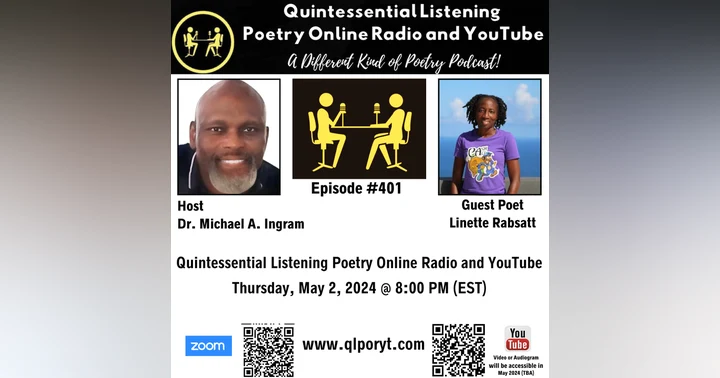
QLPORYT Presents Linette Rabsatt: Encore Poetry Interview and Reading

A Different Kind of Poetry Podcast
Episode Summary: This episode is an encore audio presentation of an interview with Lynette Rabsatt, a poet from the Virgin Islands who has been writing since 1996. Featuring over 200 pieces, Lynette's work aims to inspire and uplift through her blog and social media. The interview discusses the essence, importance, and themes of poetry, Lynette’s influences, and her journey from struggling in high school literature to becoming an established poet encouraged by Dr. Vincent Cooper. The episode includes Lynette sharing multiple poems, insights into her creative process, and her views on the role of poetry in highlighting social issues. Lynette also talks about her aspirations, her blog, and the impact of online poetry readings amidst the pandemic. For additional information, please visit: https://www.facebook.com/photo/?fbid=10231774469801483&set=gm.7875321479153477&idorvanity=2574804195871925
Thank you for listening to Quintessential Listening Poetry Online Radio and YouTube. If you enjoyed this episode, please consider subscribing to our podcast on your preferred platform to stay updated on new episodes. You can also leave a review on our podcast to help us improve our content and reach more listeners. Follow us on social media platforms like Twitter, Instagram, or Facebook to stay connected with us and join our community of poetry lovers. Finally, if you’re a poet or spoken word artist and would like to showcase your work on the podcast, please contact the host, Dr. Michael Anthony Ingram, at maingram@gmx.com. Thank you for your support and we look forward to sharing more poetry with you soon!
0:00 Welcome to the quintessential listening poetry online radio and YouTube podcast Streamed live from the heart of Washington DC Here you'll find a portal to vibrant voices Echoing souls and an ongoing celebration of the extraordinary power of language So prepare yourself to join host Dr. Michael Anthony Ingram and his special guests as they explore traditional and spoken word forms of poetry. Hello, everyone. This audio recording is an encore presentation of my recent interview with Lynette Rapsack. Lynette is from the Virgin Islands. It has been writing poetry since 1996.
0:57 with over 200 poems to her credit. She shares her work through her blog and various social media platforms. Her poetry aims to inspire and uplift all who read or listen. So sit back and enjoy this session with Lynette. I thoroughly enjoyed our conversation and hearing her remarkable poetry. Let's start this poetic journey. What is poetry? Poetry is an art form where you can express yourself in so many different ways. You don't necessarily have to rhyme your words. You can pace yourself. You can just have fun with it. I call it my ability to play on words to bring a positive message. Your ability to play on words, to bring a positive message. Tell me more. Slash that out for me. Sure. So let's say I'm feeling down or I'm feeling inspired. I'm feeling stressed. I could use poetry as an avenue to share something positive. I could even share something that hurts me. I could share tough situations that affect me and especially things that affect the world. So poetry is that vehicle without the music because of course, Music is poetry. Songs are poetry with music in the background
2:29 with instrumentals. So I use my words and my spoken voice to bring across a message. Lynette, knowing what you know about the world, there are people out there who believe that poetry is dying. What is your take on it? Is poetry important? Talk to me. Poetry is extremely important. I think about the Calypsoanians here in the Caribbean. The same thing with poetry. Our job as poets is to share and educate people. It is to inspire people. You go back to the Bible, you think about the great Samist who penned words that we repeat today on a regular basis. The Lord is my shepherd.
3:25 That is a poem that speaks to the depth of God's love for us and our ability to love God as well and to appreciate everything that he's done for us. So poetry is not dead. And once there's music, poetry will never die because whether you enjoy the spoken word or you enjoy the sung word, it's all the same. It's about getting that message out there. So poetry is not dead. an early experience where you learn their poetic language had power. I never thought of myself as a poet. When I did literature classes in high school, I was struggling.
4:11 I was like, I don't understand these things. But when I got to the University of the Virgin Islands and I met Dr. Vincent Cooper, he really encouraged me. He shared poems from Langston Hughes and Mutabaluka. And we had to do some writing assignments. And that's where I started to play around with it. And he encouraged me. He was like, you have a gift. I didn't think so. I thought it was for me. But he kept pushing me. And I'll share one of those pieces later on in the show where he just encouraged me. And here I am today. And the rest is history. So Lynette. What do you write about? What are some of the predominant themes of your work? A lot of my work centers around community and a lot of the trials that we go through as human beings on a one -on -one just living and then societal issues. I write about climate change. I write about love. I write about peace. I write about fun things. And my themes are all over the place.
5:26 I am an eclectic kaleidoscope of playing with words. Kaleidoscope playing with words. So, Lynette, if you're a kaleidoscope, if I asked you what is your signature poem, which one of those categories would it fall in? Which category is closest to your heart? That's a very good question. I would say it would be raising awareness in general. I think that's a predominant team. And one of the things that I've heard from persons is that my work, I always try to end on a positive note because I feel that despite what you're going through, there's always a silver lining along the way. So I always try to keep positive in everything I do on my job, with my family, with my writing. So that's what people would say.
6:28 She always tries to take a positive spin on everything. I'd like you to share two points. Thank you. The poem that I'm going to share is one of my earliest pieces from the 90s. It's called For Real. And I think this is one of them that I had submitted to Dr. Cooper. For Real, who am I that I want to be you? How to myself I am so untrue, to bleach and blush my beautiful face, throw down my blackness for the next man's race. All how the lie has burned my head, sob says, hair morphs, then falls dead. The stress, money, the tears, the burns must raise my back, blackness.
7:18 Oh, when will I learn? That's the first piece. And then the second piece is actually dedicated to my grandfather, Sanford Rapsat. May he rest in peace. It's called Black Diamond. My thick, nappy hair. makes you think that I'm rich but it's the sweet melanin that runs through my veins that is the precious jewel. My deep dark dangerous eyes are my small change that takes Take the attention from my dark, bold legs. As I walk by, watch me shine, because my body carries the heat of my passion, my ancestors' generations of intensity, immensity, and richness. My heritage is my treasure, my traits, my vision, my mentality, all expensive and desired, the descendants of a black diamond. Thank you. So Lynette, how does a poem begin for you with an idea, a feeling, a form, or an image? It's a combination. Sure.
8:35 It's a combination of all of those things. Sometimes it comes from a conversation. One of my best friends, Dr. Deirdre Weepita, she and I talk constantly and she would say something or I would say something and I'd be like, I'm going to write down that line and I'm going to make that into a poem. Other times it might be I'm out in my garden picking my fruits or doing my little weeding and manicuring around the yard and something comes to me. And also for National Poetry Month in April there were some writing challenges that were shared in one of the online poetry groups Papi's Poetry Corner. And we had writing prompts.
9:22 And then in another book that I'm in, Cultures of Pros and Poetry and Stories, we share picture prompts. So a picture prompt this month was actually, we call them Jack Spaniards, their paper wasps. I think I'll share that poem later on. You know, all great writers. have great writing influences. Who are some of yours? And what makes them great in your eyes? So my influences, like I was saying before, Mutza Baruka, Langston Hughes, but I would definitely say Bar Mali has been one of the greatest influences from me because just the way that he wrote and the way his words impacted people So I would say he's definitely one of my top lyricists and as a poet and even two pack Because I like the rhyming like the rhythm. I like the energy that they put into their work They'd say that you see the world with complete honesty one should look to comedians musicians artists and poets What do you think Lynette emerges from you naturally as you share and write your poetry? I'm giving the world a piece of my heart
10:57 with every poem that I share. I really want to inspire people to do well and to be their best selves. I want to raise awareness about the challenges that we face as a people. for me specifically as a Virgin Islands person, as a Caribbean person. So I think that those are my influence and that's where I put my focus when I'm writing. I have a question. Does it hurt you to write poetry? If not, why not? I don't think it hurts me to write poetry because I've participated in poetry competitions. won prizes. So it definitely does not hurt me even though I say I'm giving you a piece of my soul. That makes me happy. It makes me happy to be able to send voice notes to people or to put stuff on YouTube and get the feedback.
11:58 So definitely no hurt involved. I asked that question because the world we live in is not always pretty. And the things that we write about are not always pretty. These writings are based on our own stories, our own lived experiences. So that's why I asked that question. What I'd like to know now is, are you willing to be hurt by the poetry of others? I love. participating in online poetry readings, because that's where you get to hear the diversity that's out there.
12:47 So it's definitely not heard. Now, I'll tell you there's some pieces when people share them, the tears come down because you realize these people have been through so much. But the fact that they can share it and put it out there, they can heal, they can grow, and they could inspire other people as well. Lynette, please share two more horns. Thank you. Sure. It's called, music is poetry in motion. Words with emotion taught to a beat. movement in sound, instruments on fire, swinging inspiration, love in audio, sex in stereo, shouting with rhythm, speech synchronized.
13:49 Music is in all of us. Thank you. Okay. Is there a line in that particular poem that pleased you in terms of including it? in the pool or a lie that challenged you and you were not sure whether you should include it in the pool. That's a good question. I would say the swinging inspiration would be the line that I would say is my favorite because I don't think that anybody else has ever put those two words together, swinging inspiration, but I love to dance. Swinging inspiration. You've been writing since 1996. How do you think your work has changed and or developed since that time? What are you doing now that you did not do then? My work has definitely changed and as I share more poetry tonight you will see the difference because I think at first I would have spoken more about my blackness. So the first two pieces but definitely about me identifying myself as a person, as a black person, loving my natural roots and everything. But my work today, my rhyme schemes have changed. I'm playing more creatively with literary devices using a
15:22 bit more alliteration. I love alliteration. I am widening the teams a bit more, I think, because we do a lot of poetry competitions here in the Virgin Islands. That's where I'm writing more about climate change and things like that because typically I wouldn't write on pieces like that. But because we have certain avenues, I'm able to expand my writing a bit more. But of course, attending the online poetry readings with a global audience, you're getting to hear people use different styles and that definitely influences the way that I write. What is it about the poetic device alliteration that intrigues you? I'm not sure but I just find myself and I usually like pair up things and not pair but I usually go in threes Like big bad bougie I use a lot of repeated sounds on whether it's just the consonant or it may be emotion devotion motion using themes like that I find somehow my brain always clicks and then by the time I'm finished I may say I'm not going to rhyme this poem because I like to challenge myself to go further and further outside the box and I say I'm not going to rhyme this poem but then no matter what there's a line in there that rhymes or balances itself out it sounds
16:54 like You really enjoy the talent of finding out new things about poetry, the different forms, the different devices. Correct me if I'm wrong. Yes. You are correct. Like I said, when I share some more pieces. Yes, I'd like to hear more of your work. Todd, share three points. Okay. This poem is called The Nurturer. Seeing him is a richness of fulfillment. I cannot understand the depth of this love. Completion is only secondary to the achievement of being nurtured, inspired, and commended by one who distinctly resides in loving peace with himself, his surroundings, and his being. Acceptance of his philosophy is a mere decision, delighted and uplifted by the assets of his heart and loving spirit. That's the first piece. And then I'll share one called Arrest. This poem was actually published in Virgin Islands Colony, an anthology of poets here in the wider United States and British Virgin Islands.
18:17 So here is Arrest. I've never done well on my own. My future seemed like it's almost gone. As much as I try to succeed, depression kicks me at the heels. Surely, I've seen greatness and I have exercised excess patience, but the troubles of my life seem to multiply my strife. I feel I can't survive. I feel the stress of being alive. There's no sign of deliverance toiling hard for mere pittance. Believing there's a promotion but the only promoting is a notion. Some say I should feel blessed but my life's been an empty nest. I do appreciate my surroundings and I have received free higher learning. But my definition is clouded and my eyes have been shrouded. I never learned about the responsibility or the hardships of raising a family. I let people dictate my life and use my talents as their device. And now that I'm depressed and stressed, I face my time on the life arrest. And then a short one, this one is called I Have. I usually share this poem. if I'm visiting students, especially then the elementary primary level. I've seen the fall and I've seen the fall and rise. I have traveled
19:51 to the hilltops as I ask God to open my eyes. I've roared like a mountain lion. I've risen to the mighty call. I have lived in the naked nature and I've sat in trees, majestically tall. I've prayed with the downtrodden and I've given them a helping hand. I've seen the struggles of 10 ,000. I walk with them on the black sand. I want to be among the mighty. I love nature's open call. I wish for peace among the nations and for us to stand strong and tall. Thank you. That was an exceptionally powerful set of poems.
20:34 As I listened to you, there was a difference in your voice. It was stronger, a different resonance. Wow, very, very nice. Let's talk about the third piece. Were there lines in that particular poem that you felt really pleased about in terms of including or you felt challenged as you thought about whether you should include them or not? Okay, with this particular poem... I don't remember what was happening to me in life at the time, but when I wrote the first four lines, because those would be the first four lines, the mighty fall and the fallen rise, the hilltops and asking God to open my eyes, I would say that's the part that touches me the most. The praying with the dawn trotting and giving them the helping hand.
21:29 That's the path where I would I struggle as a human being and struggled as a writer to put that together bearing in mind that I started off with the mighty fallen and then having to pray with the downtrodden. What I'd like to know is is writing a poem letting you guard down or building a wall? It depends on what the poem is about. Sometimes it is letting that guard down and putting yourself out there to be vulnerable as well. It could be up a while because you don't want to face something and you prefer to express it in words because I've been through situations and I've written poems because okay, I can't express it. I can't go out there and scream.
22:23 I can't post certain things on Facebook, but I could. take my time and put it nicely in a poem and who's close to me will understand exactly what I'm trying to say. Other people will be like, oh, that's so creative. And in the meantime, my heart is breaking. I'm hurting. Right. I know. And that they say that poems are often like living creatures. Once out there, there's not what you can do to correct or improving? While others edit meticulously, not leaving much from the original draft form, what is your take, Lynette, on the editing process and poetry? With the editing process, I'll be honest with you, some of the older poems from in the 90s have gone back and made some changes. Typically, when I write something, I just make sure I do the grammar check and I do my spelling check. And once I'm okay with that, I typically don't change it. But depending, let's say someone asks me to do a poem for church or for a particular event. I may tweak something, because sometimes people ask weird things. Because obviously, okay, Mother's Day is coming up. I have a lot of poems about moms, so I don't really have to tweak anything. But one time I had to do a performance for my job, and I wanted to be able to get involved. So I did some repetition
23:57 with the word yes. So I could get the audience involved and also send the inspiring message while making it interesting. So to me, I try to cater to work based on the audience, depending on what it is, especially if somebody asks me to perform. And of course, obviously, if I'm doing something for church, I'm going to make sure that it's wholesome. It's godly. If I could make references to the Bible, I'll make sure I do that. Lynette, when you think about poetry, what do you think makes your work unique? Now, it would be easy to say, well, I'm unique, and that's fantastic. That's a fantastic answer.
24:42 But I want you to flesh that out. What do you think that you bring to the poetry world that is different from someone else or group? Talk to me. I think that my ability to play with words and play on words makes me unique. I think also my ability to hear certain things and then drawn it and turn it into a poem because on one of the poems, the next one I plan to share would tell you exactly why I'm saying that because it's a poem about Bob Marley. But when I say Bob Molly vibrations people are thinking I'm probably talking about Smoking weed or something like that, but it's actually his song titles in a poem and The way I perform it. I think that all of that is what helps me to be unique Share the poem I look forward to hearing it. So this poem is called Bob Molly vibrations As I catch a fire and stir it up, jamming in my mind is how to satisfy my soul. There is so much trouble in this world, but yet I feel like an iron lion in Zion. I know I'm never waiting in vain because this exodus is more than a natural mystic. I
26:15 ask myself, could you be love? But I know that while you feel I am on a raster man vibration I'm just gonna chant down Babylon and then I'll get up stand up because the system that was designed to screw us will never beat us because this one love Positive vibration is all we need to live up free up and sing the redemption song. Thank you You know, your delivery is perfect. What is the relationship between your speaking voice and your written voice if there is a relationship?
27:04 I usually type up my poems and then I, depending on what it is, I play it back. So I let Microsoft Word read aloud, read it back to me and listen to how that sounds because of course that's monotone. And then, I mean, do it as a voice note and hear how I sound, but I tend to practice the poems sometime. And that's why I like having the YouTube page, because that's a way to put the work out there and to get me performing, because really, actually what I want to do is more performance. So using the YouTube and hearing the playback, then I know, okay, I need to focus this word differently. I need to emphasize this phrase more. And I guess growing up in church and doing recitations that have this and different activities, I have the next to show the voice when I need to treat. And actually one of the persons who's on with us right now, she taught us to drama.
28:06 And she came to support me tonight. So I just want to say shout out to Mrs. Manners and to Justin Hatch for being here with me tonight. Very nice, very nice. When you read Lynette, you come alive. There's a different radiance, a different regalness. It's a wonder to see. So when the poem is at the starting line, Who's driving? You or the poem? That's a very good question. Depending on what it is, it might be the poem. And there are other times, I guess, if I'm writing for a competition, and sometimes you have to force it, so writing me to, I take over. But when the words are flowing, that's the poem. that's the inspiration coming. Especially when you do picture prompts, I love picture prompts for that reason because you look at the photo and very often when I do picture prompts, it looks nothing like the picture, but there's something about whatever is being depicted that kind of evokes the emotions in me and I'm able to draw from it. Sure. Let me see what I can find to
29:39 share with you. Okay, this is a more recent poem. This is another one where I played with alliteration. It's called Under. I don't think that you understand how underwhelming it is when you underestimate your power. You may say that you are under siege or underappreciated, but these undertones only serve to keep you underground. And while my poems may be unsound, underneath it all, I try to unseal the secret dealings, the undeveloped feelings that underpin the unending reams of dreams that are so disruptive, that are so corrupted. Look.
30:25 You can't let anyone undervalue your words. No one should be able to undermine the values that underpin your fate. Now, do you understand? Thank you. So this other poem is called De -Stress. Because of course, life is full of stress. So de -stress. Life is full of test. It's almost like a crazy contest with no context and you spend most of the time being frustrated and vexed feeling stressed and distressed with no avenues to de -stress. But I must confess that sometimes the best defense against stress is to ignore the mess and take time to invest in just feeling and doing your best because every day is another test. and whether you run from the east to the west, somewhere there's going to be a pest. Something will make you feel hopeless. Someone will be ghetto or classless. And you still have to smile like you're feeling the best, like you're living a lavish life of richness. But maybe I digress because living at your best is where you get past the emptiness. So find your happiness even if it's only temporary. and has no permanence.
31:52 But remember, conflict unaddressed is another ingredient for this stress. So you have to use your common sense. Challenges are the cause of stress, but that doesn't mean the outcome won't be the best. because stress also has its goodness. When you get that feeling, sometimes you just have to consider forgiveness. And yes, just take a rest from the conflict and distress, the nonsense and the pettiness from the major media madness. Maybe just mind your business, walk away and just focus your time and invest in yourself.
32:33 Thank you. When you think about your craft, being a poet. Do you view yourself as being a storyteller or a wordsmith or a combination? These two. Okay, I think I'm a combination based on the different things I've written. So definitely the poem distress. That's a wordsmith. But when it comes to other poems, like I wrote a poem about my great grandfather, that's That's the story teller in me because in my heart of heart I really want to be able to tell stories, but I just Haven't gone down that road. I guess the poem is a short version of being able to put the work out there and Sometimes people just need a little sprinkle a little fairy dust. So the poem is like the little fairy dust Here's some inspiration take that go and be great go and feel sad but know that tomorrow is going to be different. Let's imagine for a moment that writing a poem is like baking a cake. What are some of the ingredients that you'll need to write the poem? A concept or an idea that you want to express. For me, sometimes it's just one line and then I run with it. You definitely want to
34:05 consider how you line up your poem visually, because it's one thing to be able to perform. But when you look at it, sometimes people still write the poem basically in a paragraph. So you need to understand what poetic form is. And it's good to do research to understand what the different types of poems are. because whether you do a haiku, a sunnet, free form and what I'm realizing from going to these online readings is that there's so many things that we've never thought about or that we were never taught in school where what people are doing with their poetry especially visual poetry and shapes. You know poetry is so eclectic and so different you could just have so much fun with it. And of course, I encourage people to look up literary devices, understand sounds. So even though you may be reading the poem the way you write it, your voice comes into the reader's head. Or if you're performing it, knowing when to do that pause, and when to soften that face. So you make the reader tune in a little bit more, or the listener tune in a little bit more to say, okay. I get where she's going, I feel her pain, or I feel her energy, I feel her singing, I feel her dancing. For me poetry you have to do your research, you have to read other poets, listen to other people, whatever music
35:37 inspires you, whatever you enjoy, take some influences from that as well too. What do you think your work, your poetry conveys about the human condition? My work and the human condition, I think I try to capture a lot of different aspects of the human condition. Even if you just look at our basic needs, the food, shelter, the ability to be free, loving yourself as a person, your self -esteem, the struggles you go through on the job, or just out in the traffic. the nature around you the things that are impacting our planet the politics because definitely politics plays a very big role in the way we write because your writing is usually influenced by what's happening around you so for me I try to draw from all these different things and share my words with the world. Lynette in this life that we live there's good There's bad. There's ugly as well as indifference.
36:54 What do you view as being the role of a poet in modern day society? The role of the poet is to highlight the good, the bad, the ugly and the indifferent. Now the key thing is when you're crafting your messages. It could be all bad. It could be all ugly. It could be all good. But If all your messages, so if me as a poet, if everything that I'm saying is just about the ugly, after a while people will tune out. So you need to be able to highlight the awesome things that are happening. But then you need to hold people accountable with those words as well too because poetry is an excellent avenue to be able to hold people accountable and let them know, hey, we're not. happy about this especially when it comes to politics like I said depending on the type of work that you do obviously you won't go out there and say that you're right upon about your boss being the worst person but you could write a poem about a snake and it could be about that situation but you use your metaphors you use your literary devices that's what they're there for. Some believe that we're required as poets to write about social issues or those things that happen in our world. Small picture and big picture. But what if I want to write about rocks
38:28 and trees? Why am I required to write about social issues? Talk to me. Tell me what are your thoughts? I think that each person, everybody's unique. So, you know, I could write about rocks. I could write about the issues in the world. Some people just enjoy doing that one particular thing. There's an avenue for them. There are people who are going to enjoy that. There are people who need that. And then there are persons who are always political. This is happening. That's happening. Places on fire. And there's a need for that.
39:08 So that's why you need to have the balance. Everybody can't be saying the same thing. And the same thing with music. Every music can be everything every song on a radio can be ready Every song on YouTube can't be hip -hop. You need to have that mix because some days you wake up and it's Okay, I'm feeling like I could listen to some young doc today and then another day I would say I need to hear some Bob Marley. I need to Mellow it down then another day be like, okay, I need some coke Franklin because I need to calm down even more So you need to have the balance It can't just be one thing. It can't just be one message out there. It needs to have that mix. Based on what you know about the world, your own lived experience. What color is poetry?
39:56 Poetry is a kaleidoscope. To me, it can't be one color. Because even with emotions and even when we as humans go through things, a lighter skin color. If you're happy, you will laugh till you turn pink. If you're sad, you could see the facial expressions change. If you're angry, you're going to turn red. Even as a human being, if I get bruised, it's going to turn purple even though I'm dark skinned. So for me, poetry can't be one color. It has to be that kaleidoscope. It has to be At one end of the spectrum, white one day, it needs to be dark another day. Some days it's yellow. Some days it's green. Maybe I'm just a little envious of everybody. But I think it needs to be a combination of everything.
40:52 Please share another poem. Sure. So this poem is a political poem. It's called writes. I'm always hungry. But nobody wants to feed me. I don't know why. They just ignore me. The doctor says I'm dirty. The teacher doesn't want to teach me. They say I'm stupid. I try hard, but nobody at all wants to bother with me. I can't get a job. This makes my life hard. It's real hard all the time. But it's a surprise. They're letting me vote. I'm thinking is the law of the mother country that is that let me vote. I have suffrage, but the elected ones don't realize that I'm suffering.
41:51 Thank you. Wow. I think I like to hear you say that one again, please. Sure. always hungry, but nobody wants to feed me. I don't know why they just ignore me. It says I'm dirty. The teacher doesn't want to teach me. They say I'm stupid. I try hard, but nobody at all wants to bottle with me. I can't get a job. This makes my life hard. It's real hard. all the time. But it's a surprise they're letting me vote. I'm thinking it's the law of the mother country that is that let me vote. They call it suffrage. But the elected ones don't realize that I'm suffering. Thank you. Tell me about the message in that poem.
43:04 So this is one of my early poems that I wrote at UBI. So this is a very old poem. I think this is one from 1996. This poem, it was the first time I learned the word suffrage, the right to vote. So I don't know, in my head, I started to play with, okay, suffrage, you have the right to vote, but we're suffering. The roads have potholes. The water isn't running the way it should run. The salary's at salarying. And in my head, I'm like, suffering, suffrage. So that's where I started off with, I'm always hungry and just building it from there and then twisting it around to say, hey, I have suffrage, but yet I'm suffering. The end was melancholy because I can vote. I have children. My son is over 18, so he can vote. But then you look at the state of the country, you look at what's happening in the world, and it's okay, are these elected leaders really paying attention to what's happening?
44:08 We are suffering. All right to vote is what gave them that job. But yet, here we are, broken, so many things that need to be addressed, whether it's education, mental health, it's a lot that's happening. So even as I say these words now, it still breaks my heart. This form still breaks my heart today because we are still suffering. More people have the ability to vote, but yet they still continue to struggle as a people. For me, living is just a challenge in itself, trying to understand myself, monitoring my behavior, how I react. how I deal with things, how I deal with people, especially as an HR manager, because of course being an HR manager is about dealing with humans and their emotions, their compensation, things that affect them. When you hire someone, you hire them and their family, their broken car, their home that's maybe taken away from the bank, you hire them as a full person. And just the same with poetry. It's about evoking that emotion and trying to send that cam, send that word out there. But of course, sometimes it is about putting a little fire under people to say, hey, wake up. It's time to do something different. It's time to call, make a call to
45:39 action. So some poems are about calling to action and saying, hey, guys, let's do this. What do you think makes poets different from other people? I think poets are regular people who just are more in tune with being able to share their work. And this is the thing with poets. Not everybody wants to share. Because I have this one friend who I love so much, Toya Foy. She's just so amazing. At some point, we're going to get her to build the courage to come on your show. Because she has a lot to say. All right. She's invited. I'm going to work on her. And being a poet and putting the work out there, it puts you in that uncomfortable position. I've been on the stage where I've said things I shouldn't have said, but I know better now. Sometimes you have to grow and learn and get yourself together, but definitely you can see I love poetry. The encouragement from Dr.
46:50 Cooper really inspired me to put the work out there. At that time, they used to have poetry readings while we were there in school. And you get more encouragement. And when I came, because that's in the United States Virgin Islands, I actually live in the British Virgin Islands on the island of Tortola. And when I came back home from school, I would send my poems to the newspaper because I actually saw a few people sending this. to send my poem too. And that's how people get to know that I'm writing, I'm into poetry, and that's how at church they would say, okay, can you share a poem or if there's an event that one of the government departments is doing, they may reach out to me. But I personally feel I use the analogy, I use the parable from the Bible about the talents, and I take it literally. I don't look at a talent as being a coin. I look at it as your gift from God and if you have a gift from God it's your job to share it writing the poem or keeping it in your head or keeping it locked away in a book isn't helping anyone it isn't helping you as a person to develop further and it's not inspiring anyone and that's the point of poetry and music to share it because I keep saying the same thing it's about getting that message out there and inspiring people to see something different and to understand that change is inevitable. So share the work. I'm
48:21 encouraging anybody who's listening, please share your work with the world. Please share with me the titles of five of your poems. Okay, a Michael Jackson story, our treasure. Let me see, inspiration, unable to sleep and loving me. So that's fine. All right. Okay, okay. My questions are as follows. Are titles important? And what comes first? The title or the poem? I think titles are important.
49:10 They're not mandatory. but they are important so that when someone sees the title, it may intrigue them to want to read more. For me, the titles come after. So I would put the piece together, even if it's something for a competition or something that somebody asked me to write. The title comes after I put the piece together. I think one that I did for a climate change competition, I think I got lazy that day and I just made it. made a title, Climate Change. I have another one, Planet and People in Harmony. I think that was a theme for something. So depending on what the theme might be, I might use that, but I like to play around with my titles. I don't think my titles are always the right things either, but at least if I'm able to search for it, and especially because I share a lot of poetry on my blog, it needs a title. I can't put everything I'm saying untitled. We've reached the part of the program. That's my personal favorite part.
50:15 This is what I view as being a mini poetry lovers concert. This is an opportunity for you, Lynette, to share four or five of your poems back to back uninterrupted. No questions from me. Lynette, you're on the stage. Yes. So I am going to give you some additional pieces. So I'm going to share a poem about the Virgin Islands first. It's called Our Treasure. A gem that is worth more than gold. and is full of history untold. An oasis where you can replenish your health, where nature is the true wealth. A pasture, a place that settles the soul, where the seawater never turns ice cold. A creation with natural wonders and sights, where the trees sway in the light like kites.
51:14 a banquet of beauty, nature, and flavor with tasty fruits and tea bushes that you can savor, a population of people with friendly smiles, a flora and fauna in expanse for many miles, of birds soaring freely in the sky, and sea life that exponentially thrives. Our BVI, loved and cherished by many worldwide. who often come to visit and reside. Thank you, that's my first piece. And then the next piece that I'm going to share is called Unable to Sleep. This is one that I wrote for a poetry, the Poetry Month Challenge that I talked about in Papi's Poetry Corner, Poetry Group. Weariness is not enough. Neither is drariness to make me fall asleep. No matter how deep I think, nor how many sheep I count, the hours fly by. I am still awake and alert, so I pray to be inert so that my thoughts don't wander and constantly meander through the purple purples of my mind. As I recount embarrassing moments, snap judgments, broken commitments, thoughts that are indecent, failures that are recent, possible entrapment, dreams should be
52:46 full of enjoyment. Because being lost in sleepless thoughts is like experiencing a nightmare that plays on your brain. And the only way that I maintain sanity is through prayer as the hours elapse. That's my second piece. And then I'm going to share another piece I'm scrolling through my, ah, this one is called what I really wanted to say. This is what I really wanted to say. I like this place and the pace that I'm going because I'm growing and knowing where I came from, how I defied the naysayers and those who didn't want to see me win because they just wanted me stuck in sin, seeing me as a broken pin that can never be mended. But in the end, I ended up living beyond defeat, breaking barriers and kicking away the seat. I really wanted to say that I love you because you inspire me to be a more articulate and thoughtful poet. inspired to be the best me. Thank you for that piece.
54:10 And since we talked about colors, I'll share colors and then one last poem after that. So colors. Today was like a splash of red and blue. I didn't know how to counter, but I saw me in you. At points it was low with a hint of yellow. Despite the situation, I tried to keep mellow, but my heart was tense of purple and beige. I couldn't help anyone. I was in a perturbed phase. Could it be that my tears were black or did I focus too much on the talent I lacked? Maybe I'm the monster with eyes, Pickle Green, because I've gotten too focused on friends who remain unseen. Maybe my lips are shade. of Maroon, from kissing the feet of those who bay at the moon.
55:05 But when I'm happy, my eyes turn brown because it's easier to smile than to wear an ugly frown. And the last piece that I'll share with you is one that I love to share. I just need to find it. It's called Journal. Yes, Journal. I can write a poem every day. I guess that means I have a lot to say. I think I can affect some change. I think my poems will help you understand. I think my pieces from an amateur hand will make you think, help you understand that sometimes life is a real demand. My simple words from a thought which occurred while making juice or eating fruits, reading fiction or inhaling truths might inspire you to write your own or make you think about what is shown. My poems may not all come from experience, but seeing through someone else's events. Poems of love and community life, poems of politics and peace alike. I hope I encourage you to write. Your pen is your messenger. Use it well. You may not know the joy you tell. The heart you may inspire. Love of poetry. Styles
56:36 of fire. Thank you. I really do enjoy writing and playing with words and I was saying that I have been an avid reader from the time it was very I read a lot of fairy tales and a lot of different books. And I think that helps to influence me the way that I write. And definitely the class at UVI just opened my eyes a bit more. If I didn't have that experience, I don't think I would be on here today and have that level of confidence. Now, do you believe that you were destined to be a poet? it might be true that I'm destined to be a poet because from 1996 to now that's a very long time and when I look at my work and I would say I'm probably destined I would have never taught that I would have never taught I would have been a HR manager either but there I am today I think I'm a life of anomalies and just being different and sometimes doing things on the spur of the moment. Even though as you get older, you tend to plan things and be more organized. But when I was younger, I was spontaneous.
57:57 So sometimes it's just to have the encouragement and having the right people behind you and saying, hey, I think you have something and I really have to give that shout out again to Dr. Vincent Cooper from the University of the Virgin Islands for just. encouraging me and everybody from the rock collective in St. Thomas, United States, Virgin Islands, the Kalalu Ports here in the Virgin Islands, people like Allyson Blacks -Archer, Deidre Whitley -Peters, Toria Foy, Justin Hart, who's on here April Glass School. It's so many people that I could mention who have really been there for me and who've encouraged me, Akid Shinori, Arthur Nellie V. Yeah, I have a lot of people in my corner who really support my work. Yeah, that's wonderful. What do you think? Since 1996, your beginning, in terms of your writing, what have you learned about yourself? I think I've learned quite a bit. I've learned that I'm more patient. I've learned that I'm a bit deeper.
59:06 I think I was when I was younger, young people you don't think about anything, you don't plan for anything, you're spontaneous. Somebody say, hey, come, let's go ahead. You just pack up and go. No passport, nothing in you. You're out there. But I've learned to be more reserved, to come a bit more in tune with my emotions and using the ad form to be able to express and knowing especially having children that helped me to grow a bit more because I think I went through a dead phase when I wasn't writing. But that blog, my blog words of ribbon, I think that pushed me quite a bit because I was like, okay, I want to build content. You don't want to be a content creator. And you can't be a content creator if you don't have content. And it didn't start off being a poetry blog. It started off with just sharing random thoughts. But I said, you know what? At some point, we all have to leave this earth. And I would want to know that at any point something happens to me, the work is there so people can find it years and years to come. it would be there that hey she said this she said that maybe i had a premonition and i saw maybe i'm seeing something that would happen in the future i want people to be able to appreciate my work even after i leave wow we've come to the end of our poetic journey where can people find your work i know you've got the blog where else can people find your work because you have
1:00:37 a book as well Yes. So you can find me on YouTube as well. Everything for me is L .A. Rapsat, even though people mix that up. My name is Lynette, but my YouTube is L .A. Rapsat. My Facebook is L .A. Rapsat. I also have a page, Lynette Inspire VI. And I have my Twitter Pinterest. And yes, I do have a book that I published. It's a Kindle version book. And the funniest thing about the book is that I don't have a kindle, but I have a kindle book. But in doing my research, I realized that, okay, that's a very free option for publishing and putting the work out there. So I just pulled about 14 or 15 of certain pieces and the Michael Jackson poem is in there. Just to share, just a snippet. Because people keep encouraging me to write a book. But let me tell you, when you're in the Caribbean, shipping is very expensive.
1:01:38 So doing the Kungu version book was a lot more affordable for me. Very low cost. It literally cost me nothing. And my son is a graphic designer. He designed the cover page. So I have that book out there. At some point I'll do some more Kungu books. For right now, putting the work out on the blog, I think that works for me because at least it's free and people could find it anywhere in the world. And I personally feel that being a poet It will never make me rich. I don't want to be rich. I just want to be comfortable and lead a good life. But at the same time, I would like to be like artists like Mutaburuka where people invite me to travel and share the poetry.
1:02:21 It doesn't have to be that they're paying me or anything like that, but just the opportunity to go and travel and perform at different venues. That's one of my goals that I would want to see happen. Where do you go from here? What's next for you creatively? Creatively it would be to keep adding to the collection. I honestly don't have a proper account because I think at some point I lost one of my files with my documents. But in one document, there's about 269 and I think on the blog maybe over a hundred. I would like to continue to build that collection and I would like to continue to enhance my writing abilities using other literary techniques, different poetic styles, and performing more online. I'm actually going to be featured on the CAPS online program in July. So I'll be sharing information about that in July. Yeah, so I've been, and I must say, COVID was a very hard time for everybody in the world. We lost so many people. But it opened other avenues for people like me who would have just been here putting stuff out on the blog and putting stuff out on YouTube and not getting the reception but the online Poetry readings because people open them up because people want to share It's giving me a new avenue for performance
1:03:52 and being able to meet people like you and I must say a big appreciation and thank you for you because I When I sent the Facebook message, I was like, I don't know if he's going to answer. When he answered, I was like, let's do this. You're phenomenally talented. If there's anything that I can do to help out. I will. And I'm just glad you're out there. I'm just glad you're out there. Still craving poetry? Hundreds of episodes of the quintessential listening, poetry, online, radio and YouTube podcast are available to listen to or download on iTunes, Spotify and other streaming platforms. To learn more about the popular podcast or how to become a guest, visit www .ql .com.
1:04:54 P -O -R -Y -T dot com. Till next time, take care and let poetry ring somewhere throughout the land.